
Would you jump at the chance to get involved in a project combining two of your childhood passions? Back in 2019 I had the opportunity to do just that when I heard the Royal Astronomical Society (RAS) were looking for volunteers to help stitch a quilt to celebrate their upcoming bicentenary…
The RAS quilt plan
Annie Hogan had the idea for the project and was a super leader. Welcoming, encouraging and keeping the focus on the beauty of a community stitching project (rather than slipping into perfectionism).
The original plan was to make one quilt.
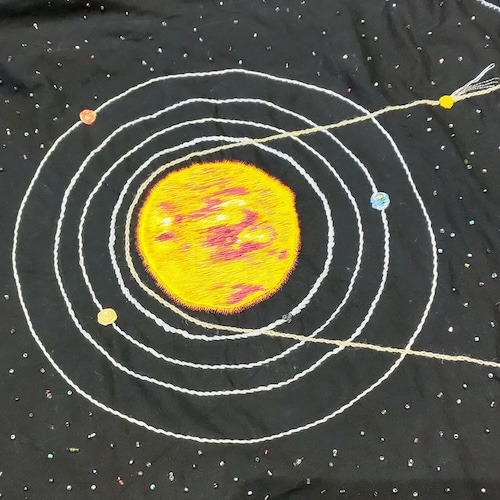
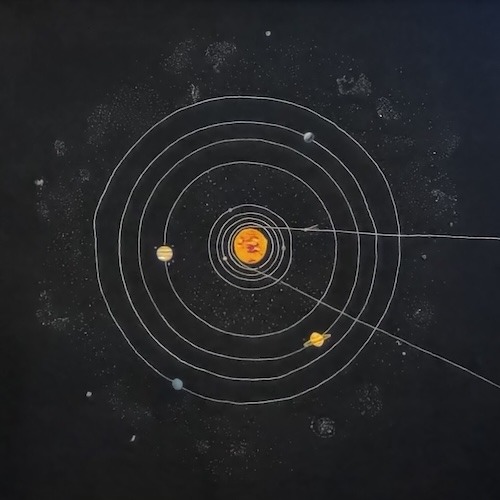
The front would depict the solar system in homage to Ellen Baker’s 1876 solar system quilt. (Ellen used this as a teaching aid, what a great way to make the solar system come to life!)
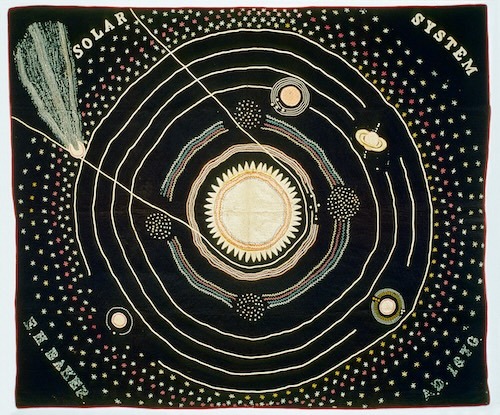
Image credit: Smithsonian Institute / National Museum of American History
https://americanhistory.si.edu/collections/object/nmah_556183
Then the back would be made up of patchwork squares depicting astronomy and geophysics subjects.
Getting started
I managed to attend two community stitching sessions at the RAS before the full force of the pandemic hit and everyone was forced to stay home.
You didn’t need to have any stitching experience to take part, so most attendees were taught stem stitch which was being used for the planetary orbital paths.
Since I was quite comfortable stitching, I jumped in to stitch a planet.
Saturn was the obvious choice for me. Thanks to my previous time on the Cassini-Huygens mission’s magnetometer team.
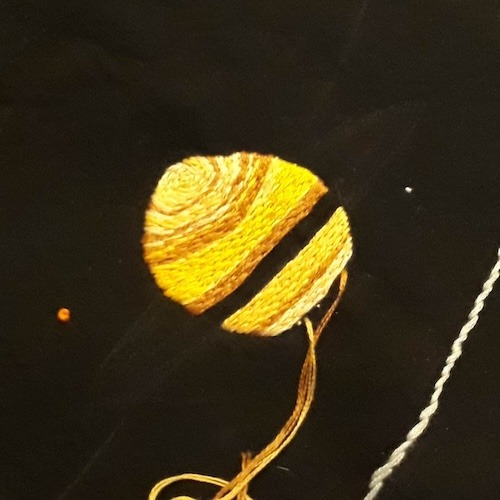
I decided to use long and short stitch (or lines of long split stitch, however you want to look at it!) to capture Saturn’s stripes. Being conscious of the time it would take to stitch, I worked with three strands of stranded cotton.
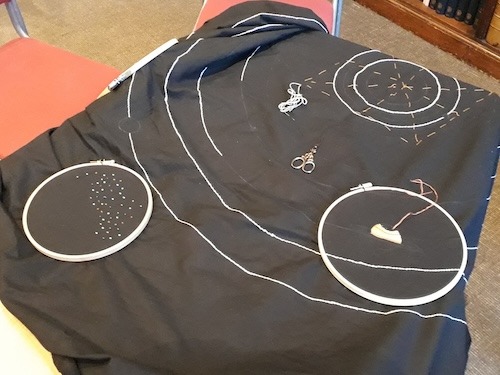
Below is where I’d gotten up to when the pandemic put a long pause on the community stitching sessions where I could work on Saturn. So close!
Going online
After the initial shock of lockdown, Annie set up a regular program of community Zoom sessions for people to get together while working on squares for the patchwork side.
I believe there were contributors from all over the world. Many making more than one square. I suspect the pandemic gave quite a boost to the number of squares created!
For my square, I chose to depict the Huygens probe descending down to Titan (Saturn’s largest moon). With the Cassini satellite and Saturn in the background.

It’s mainly made with appliqué (using leftover fabric from clothes I’ve made). With a bit of surface stitching embroidery for the details.
The long beam coming out of the Cassini satellite is the magnetometer – the instrument that provided most of the data I used.
A change of plan
Annie received so many patchwork squares, that the patchwork side ended up being much bigger than anticipated.
And she was so impressed with the variety and everyone’s creativity, that she quite rightly didn’t want to hide these squares on the back. So the plan was changed to make two quilts!
Back to the solar system
Eventually the community stitching sessions at the RAS could continue and I was able to finish stitching Saturn.
I used gold passing thread to make its rings pop. And decided to add in the moons Titan and Enceladus since the Cassini-Huygens mission proved both of them to be fascinating worlds.

My one little regret is that I didn’t take the time to stitch a split stitch outline to Saturn before working the filling. This would have really helped me to ensure that I stitched a nicely circular planet.
Rather than the slightly wonky one this is!
Ah well, you learn more from your mistakes than your successes as they say… 🙂
Another planet
By this time, most of the planets still needed stitching and Annie hadn’t had many volunteers, so I offered to stitch Jupiter.
A fellow Royal School of Needlework Certificate student, Julian Keeley had taken on the impressive job of stitching the Sun. Given how big a task that was, he’d agreed with Annie to take the quilt home with him for a while. I imagine it took many, many hours of work!
Which gave me the idea to stitch Jupiter on a slip. I.e. Stitch Jupiter on a separate piece of fabric, so I could stitch it at home, then sew the finished planet onto the quilt in just one session at the RAS.
I wanted to use a different technique to Saturn and was aware of the importance of including Jupiter’s famous red spot. So I took inspiration from Or Nué, couching down rows of stranded cotton instead of gold threads.

Before stitching Jupiter onto the quilt, I stitched the four Galilean moons directing onto the quilt.
The other stitchers who were beading the asteroid belts during the session were very accommodating of my need to move all around the table as I stitched Jupiter down!
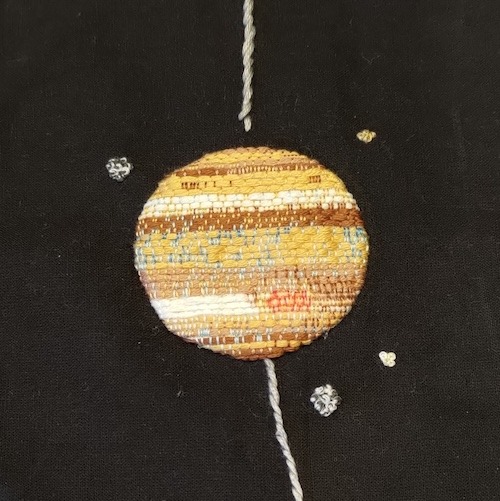
The little mistake here was that I forgot to check the orientation of the quilt before stitching the moons. So they’ve ended up in more of a polar orbit than an equatorial one. Oops, but perhaps also one of the nice nuances of a community project like this.
Even more planets
By this point the quilt was sooo close to being finished, but the inner planets remained unstitched.
So I got the honour of stitching them too!
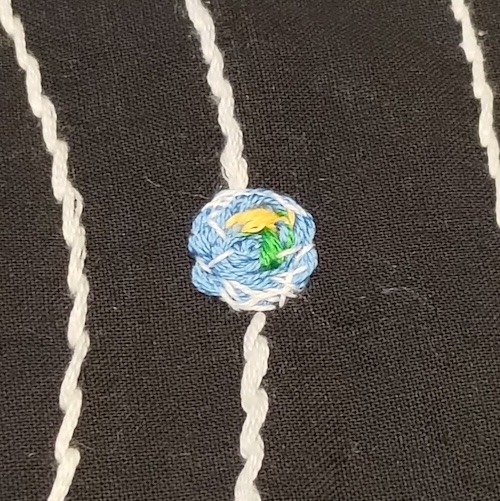
Given that time was of the essence, I went for relatively quick woven wheels for Venus, Earth and Mars.
And just three French knots for Mercury since it really is a relatively tiny planet. You may have to take a very close look, but it is there!
It felt only right to add on a little detail to the Earth. So if you look closely you can (hopefully!) see the Sahara and Africa along with clouds and the Antarctic ice. For the sake of time, I decided to capture Europe on a cloudy day 😂
With the inner planets done, we had the pleasure of announcing the solar system stitching complete at the end of this session!
It was such a joy to admire the full thing that we’d been working on for years.
And when we turned the lights down, it was a delight to see how the beads used for the asteroid belts sparkled!
Finished RAS quilts!
The quilting and finishing of the quilts took a few more community sessions. But finished they now are!
The quilts have been touring a little already and the hope is to have them displayed in many more spaces so lots of people get to enjoy them.
In October, the RAS hosted a ‘toast the quilts’ afternoon where we got to see the two finished quilts together in the beautiful setting of the RAS library.
Don’t they look amazing?
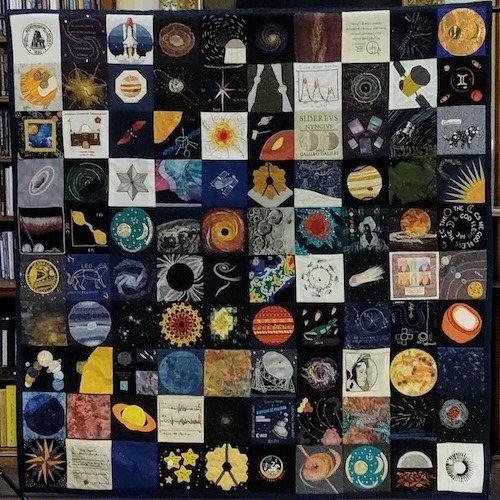
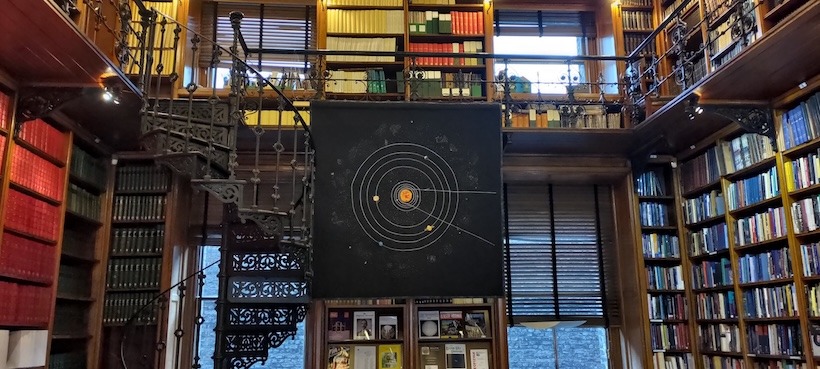
In attendance at the event was Sue Nelson, co-host of the Space Boffins podcast. Sue interviewed a few of us and included a segment about the RAS quilts in the November episode of the podcast. It’s great to see a creative project getting exposure within the scientific community! You can listen here.
It was such a joy to work on this RAS quilt project. I loved attending the community stitching sessions and it felt like such a perfect project for me.
At the ‘toast the quilt’ event, the other stitchers and I agreed that while we’re super proud of the finished quilts, a part of us will miss working on the project. I’ll just have to keep an eye out for more community stitching opportunities!
Links to keep exploring…
- The Smithsonian’s page about Ellen Baker’s 1876 solar system quilt
- RAS page announcing the quilt project
- RAS page about the finished quilts, including a list of exhibitions where you can see the quilts
- RAS page featuring all 100 patchwork squares (you can click on any of the squares to discover more about it and it’s maker)
- Space boffins podcast episode including a feature about the RAS quilts
- Learn more about the Cassini-Huygens mission